
SCULPTURE
Mononoke Soul, 2018–
Man-made waste combined with feathers, moss, gold and porcelain gives form to the souls of living beings whose boundaries are blurred.
View Works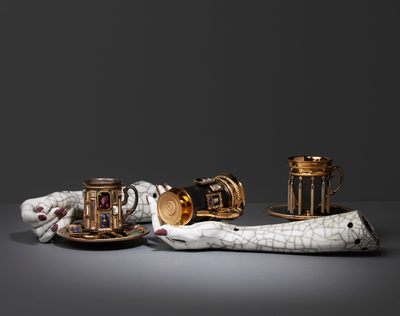
Ceramic Artist & Contemporary Artist
東金聖
Exhibition
at Kiln TOKYO
On view: “Collector’s Edition — One-of-a-Kind Vessels” by Hijiri Tougane herself, and “Atelier Line” vessels crafted by artisans she has trained.
§ IWorks
Though they use different materials and methods, all of them share at their root the same question: can a work reflect its time and remain for the future?
Mononoke Soul, 2018–
Man-made waste combined with feathers, moss, gold and porcelain gives form to the souls of living beings whose boundaries are blurred.
View Works
Miseru Utsuwa, Tsunagu Giho (魅せる器、繋ぐ技法), 2014–
Vessels in which everything, down to the small objets, the crystal bases and the picture frames, is formed from a single piece of clay — the Mino technique of Gaba-ikomi.
View Works
Supernova Explosions
Cell division and the Big Bang, DNA and the soul — micro and macro worlds painted in layers of acrylic sheets.
View Works§ IIAbout Artist

Hijiri Tougane is a Japanese ceramic artist and contemporary artist based in Toki City, Gifu Prefecture.
Born in Tokyo, she spent part of her childhood studying in the United Kingdom, and later studied art in the United States after graduating from high school in Japan. In 2012, she received her BFA from the Academy of Art University in San Francisco.
Her work spans a wide range of expressions, including life-size ceramic human sculptures, functional vessels, and abstract forms. She continues to present her work actively in Japan and abroad.
My work centers on themes such as the passage of time, the transmission of traditional techniques, and the ambiguity of human existence.
In my life-size ceramic sculptures, I try to carve traces of life and spirituality into clay as a form that can last beyond time.
In my vessel series inspired by the traditional Mino technique Gaba-ikomi, I reinterpret the method in a contemporary way, questioning the boundary between a “vessel to use” and a “sculpture to contemplate.”
In recent years, I have been developing the Mononoke Soul series, which explores the fusion of artificial and natural forms. Through this, I express the contradictions, uncertainties, and delicate relationships between humans and nature.
I believe that the possibilities of expression lie in the “in-between” spaces—between tradition and innovation, spirit and matter, craft and art. This belief guides my ongoing creative practice.
The Story of My Beginnings
§ IIIPress
§ IVAtelier

The vessels I, Hijiri Tougane, make are created with the Gaba-ikomi forming technique: liquid clay is poured into highly absorbent plaster molds, which draw out its water so that it sets into shape. The small objets, the crystal bases and the picture frames you see in my work are all formed together from one and the same clay. It is the only technique that can give birth to forms like these.
Vessels made with this technique, which once supported the Mino-ware ceramics industry, astonished and captivated ceramics industries around the world as “costly vessels like jewels.” The times then shifted toward mass production and mass consumption, and production centered on low-priced goods for the largest group of consumers, so “handmade products,” which take money and time, gave way to “machine-made products.” The ceramics industry gained momentum. Yet whenever something is gained, something is lost.
What the industry lost was “technique,” passed from human hand to human hand. In recent times, as people spend more time at home, more and more people around the world have been seeking vessels to decorate their interiors. Costly handmade vessels by ceramic artists have come to be sought all over the world. The output of ceramic artists, myself included, is tiny compared with that of the ceramics industry. Even when there is demand, supply cannot keep up. In 2021, I searched throughout Mino ware to find a manufacturer I could ask to produce my vessel works. What I learned there was the reality that “the handwork of the past can no longer be done.” The cause was that, as demand for handmade goods declined over many years, craftspeople became unnecessary, and the technique itself became unnecessary. This is how I came to feel that my mission in making vessels is “to create demand” and “to encourage successors.”
In April 2023, hoping that words like “Making vessels is cool!” “Amazing!” “I want to try it!” and “I want to take on handmade work in the ceramics industry once again” would be born between the industry and the generation that will carry the next era, that new successors would grow in number, and that a fresh wind would rise through the industry, in May 2023 I set up the “Showcase Atelier” (魅せるアトリエ), an atelier with a shop window, in the land of Mino ware that has supported me as an artist, on the street front of the Oribe Street tourist area, at THE GROUND MINO, a complex that kindly supported the idea.
“I want to pass this on with my own hands.” So that people will come to feel this way, I will keep on making pottery.

* The inside of the atelier is a workshop, so we kindly ask that you refrain from stopping by inside the atelier. Also, as the days and times of work at the atelier are irregular, if you would like to visit for a project or similar purpose, please make an appointment through the “Contact” page of this site, stating the purpose of your visit.

§ VProduct
Atelier Line is a series of vessels made by the atelier’s artisans, trained by Hijiri Tougane, who carry on her forms and techniques.
See the Atelier Line
§ VIInformation
Custom orders are limited to a maximum of two per individual. There is an annual cap on the number of orders that can be accommodated. When placing an order, kindly fill in the details via the “Contact” page. The delivery timeframe is approximately six months to one year from the date of the request.